| 英文說明 |
- “[The student] should look at the world with keen, healthy senses
and quickened power of observation, and then surrender to the
feeling that arises within…. This feeling penetrates the superficial
aspect of things and in so doing touches their secrets.” —Rudolf Steiner
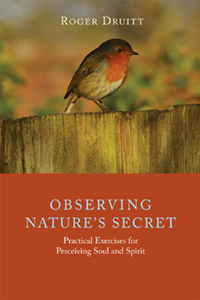
How can we progress from the ordinary, everyday vision of the senses to perception
of the subtle life and spiritual forces around us—the very forces that shape nature?
Basing his work on the research of Goethe and Rudolf Steiner, Roger Druitt begins
with a fundamental question: What can you see? He presents a series of practical
exercises for observing nature that, through diligent practice, allow the maturation
of subtle capacities of perception. Considering multiple species of leaves, for
example, leads to the concept of “leaf” itself. After this basic groundwork is
established, we can take steps toward comprehension of further aspects,
such as metamorphosis, gesture, and type.
Druitt demonstrates how this method—what he calls “anthroposophic
phenomenology”—can be applied to other fields of nature observation,
opening the way for its use in all areas of life. In each case, whether working
with bees, rocks, stars, or color, he shows how we can access the
“individuality” manifested in what is studied. Through a thorough step-by-step
process we are led to the ultimate task—redeeming the beings of nature
and of the Earth itself.
- CONTENTS
- Preface
- Introduction
- Looking at Flowers: The Greater Picture
- A Leaf Exercise
- Metamorphosis
- What Am I Seeing When I Look? A Self-correcting Path to Knowing
- Gesture
- The Type
- The Twelve Senses and the Special Case of Thought
- Glimpsing the Ether
- Bare Trees in January
- The Plant's Place within the Four Kingdoms of Nature
- Applying the Method to Rocks
- Applying the Method to Bees
- Applying the Method to Color
- Redemption of the Beings of Nature and the Earth: Joining up a Divided World
- An Astronomical Conclusion
|