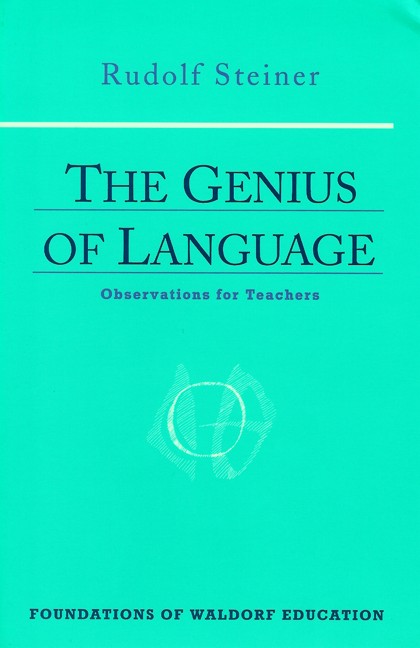
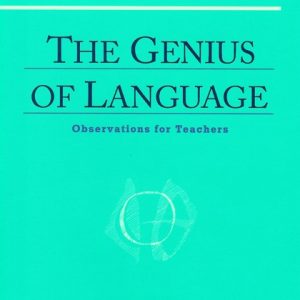
During the first year of the first Waldorf school,
Rudolf Steiner agreed to give a science course
to the teachers, which was to be on the nature
of light. At the last minute, he was asked to give
an additional course on language, which he
improvised. "The Genius of Language" is the result.
Steiner demonstrates how history and psychology
together form the different languages and how ideas,
images, and vocabulary travel through time within
various cultural streams. He describes how the power
to form language has declined, but that we can still
recover the seed of language, the penetration of sound
by meaning.
He also explains how consonants imitate outer
phenomena, whereas vowels convey a more inner
sense of events; he talks about the differentiation
of language as it is influenced by geography; he
speaks of the "folk soul" element and the possibility
of "wordless thinking"; we hear about the capacity
of language to transform us and of its importance
to our spiritual lives.
This is not just a course on language for those who
love words but demonstrates ways to teach children.
This little book will prove tremendously valuable to
both educators and parents-in fact, to anyone who
wants a deeper understanding of language and its
significance for our lives.
German source: Geisteswissenschaftlische
Sprachbetrachtungen (GA 299).