|
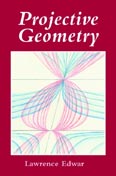
Projective geometry is a non-metrical form of geometry that emerged in the early nineteenth
century. It originated from the principles of perspective art. Here, he presents a clear and artistic
understanding of the intriguing qualities of projective geometry.
Projective geometry formalizes a central principle of perspective arthat parallel lines meet at
infinity and, therefore, should be drawn that way. Essentially, projective geometry may be viewed
as an extension of Euclidean geometryne in which the irection?of each line is subsumed
within the line as an extra oint,?and in which a orizon?of directions corresponding to coplanar
lines is regarded as a ine.?Thus, two parallel lines will meet on a horizon because they possess
the same direction.
In the spirit of projective geometry origins in synthetic geometry, some mathematicians
have investigated projective geometry as a useful means to describe natural phenomena.
The first research in this direction was stimulated by a suggestion from the philosopher
and spiritual teacher Rudolf Steiner.
In the mid-twentieth century, Louis Locher-Ernst explored the tension between central
forces and peripheral influences. Lawrence Edwards discovered significant applications
of projective geometry (Klein path curves) to organic development. In the spirit of
Drcy Thompson On Growth and Form, but with greater mathematical rigor, Edwards
demonstrated that forms such as the buds of leaves and flowers, pine cones, eggs, and
the human heart can be described simply through the use of certain path curves.
Varying a single parameterambdaransforms the interaction of what projective
geometry calls rowth measures?into surprisingly accurate representations of many
organic forms, which are otherwise not easily described through mathematics. Moreover,
negative values of the same parameter produce inversions representing vortexes of both
water and air.
Lawrence Edwards researched and taught projective geometry for more than forty years.
His book will reveal the secrets of space to those who work through its more than two
hundred instructive diagrams and exercises. Projective Geometry is an essential resource
for teachers of Waldorf education or for those who wish to strengthen their thinking
and expand their view of mathematics.
|